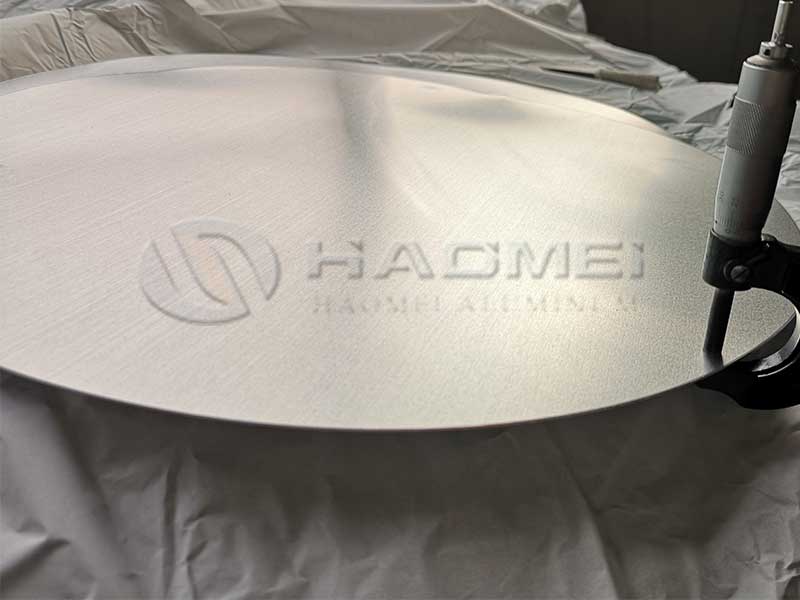

3003 Aluminium Circle for Cooking Ware Kitchen
3003 aluminium circle is one of the most widely used materials for kitchen cookware and household utensils. It is especially valued for its excellent formability, stable performance, smooth surface quality, and reliable corrosion resistance. For manufacturers of pots, pans, rice cookers, pressure cookers, and kitchen accessories, 3003 aluminium circle offers a practical balance between cost, processing efficiency, and end-use durability.
This alloy belongs to the Al-Mn series, with manganese as the main alloying element. Compared with pure aluminium, 3003 provides better strength while still keeping very good deep drawing and spinning performance. That is why it is commonly selected for cookware products that require repeated shaping, polishing, anodizing, or non-stick coating.
3003 aluminium circle is produced by blanking or cutting round discs from high-quality aluminium sheet or coil. These circles are then used for manufacturing a wide range of kitchenware components. Depending on the final application, the circles may be supplied in different tempers such as O, H12, H14, or H24.
For cooking ware kitchen applications, the most important advantages are:
- Excellent deep drawing and spinning ability
- Good thermal conductivity for even heat distribution
- Strong resistance to moisture and common kitchen environments
- Smooth, clean surface suitable for anodizing or coating
- Lightweight material that improves handling and usability
- Good cost-performance ratio for mass production
Features for Cooking Ware Use
Excellent Formability
3003 aluminium circle is highly suitable for deep drawing, spinning, stamping, and pressing. This allows manufacturers to produce cookware with consistent shape and wall thickness, even for complex forms such as:
- Frying pans
- Soup pots
- Pressure cooker bodies
- Kettle parts
- Rice cooker inner liners
- Steamer trays
Its softness in the O temper makes it especially effective for applications where high deformation is required without cracking.
Good Corrosion Resistance
Kitchen utensils are often exposed to water, steam, oil, food acids, and detergents. 3003 aluminium alloy performs well in these environments. Its corrosion resistance helps cookware maintain appearance and structural integrity over time, especially after surface treatment.
Uniform Heat Transfer
For cooking ware, heat conductivity is a critical property. Aluminium naturally conducts heat efficiently, and 3003 aluminium circle supports fast and uniform heating, helping reduce hot spots during cooking. This improves cooking consistency and can enhance energy efficiency in the kitchen.
High-Quality Surface Finish
A smooth and clean surface is essential for cookware production. 3003 aluminium circle can be supplied with excellent surface flatness and low defect levels, making it suitable for:
- Polishing
- Anodizing
- Non-stick coating
- Color coating
- Brushed decorative finishes
This makes it attractive for both functional kitchenware and consumer-facing cookware with a refined appearance.
Chemical Composition
The typical chemical composition of 3003 aluminium alloy is shown below.
| Element | Content (%) |
|---|---|
| Aluminium (Al) | Remainder |
| Manganese (Mn) | 1.0 – 1.5 |
| Copper (Cu) | 0.05 – 0.20 |
| Silicon (Si) | ≤ 0.60 |
| Iron (Fe) | ≤ 0.70 |
| Zinc (Zn) | ≤ 0.10 |
| Magnesium (Mg) | ≤ 0.05 |
| Titanium (Ti) | ≤ 0.10 |
| Others, each | ≤ 0.05 |
| Others, total | ≤ 0.15 |
Manganese improves the alloy's strength without greatly reducing ductility, which is one reason 3003 is preferred for cookware circles.
Technical Specifications
The exact dimensions can be customized according to cookware design and production requirements. Common supply ranges are listed below.
| Parameter | Typical Range |
|---|---|
| Alloy | 3003 |
| Temper | O, H12, H14, H24 |
| Thickness | 0.3 mm – 6.0 mm |
| Diameter | 80 mm – 1200 mm |
| Surface | Mill finish, polished, anodized base |
| Production method | DC / CC material, blanked or cut circles |
| Edge condition | Smooth, burr-free |
| Standard | ASTM, EN, GB, or customer specification |
Mechanical Properties
Mechanical properties vary with temper and thickness. Typical values are shown below for reference.
| Temper | Tensile Strength (MPa) | Yield Strength (MPa) | Elongation (%) | Typical Use |
|---|---|---|---|---|
| O | 95 – 130 | ≥ 35 | ≥ 25 | Deep drawing cookware |
| H12 | 110 – 145 | ≥ 70 | ≥ 8 | General forming parts |
| H14 | 120 – 160 | ≥ 85 | ≥ 5 | Stronger kitchen utensils |
| H24 | 140 – 180 | ≥ 115 | ≥ 4 | Semi-hard applications |
For deep drawn pots and pans, the O temper is often the first choice because of its superior ductility.
Physical Properties
The physical properties of 3003 aluminium circle are also well suited to cookware applications.
| Property | Value |
|---|---|
| Density | 2.73 g/cm³ |
| Melting range | 643 – 654°C |
| Thermal conductivity | Approx. 160 W/m·K |
| Electrical conductivity | Approx. 40% IACS |
| Coefficient of thermal expansion | 23.2 × 10⁻⁶ /K |
Its low density makes cookware lighter than many steel alternatives, while its thermal conductivity supports efficient heat response.
Common Applications in Kitchenware
3003 aluminium circle is used in a broad range of cookware and kitchen products. Typical applications include:
- Cookware bottoms and bodies
- Frying pans and sauté pans
- Saucepans and stock pots
- Pressure cooker shells
- Rice cooker liners
- Kettles and tea pots
- Steamer components
- Kitchen bowls and trays
- Lamp shades for kitchen lighting accessories
In cookware manufacturing, circles may be used directly for forming or as semi-finished material for multi-step fabrication.
Why 3003 Aluminium Circle Is Popular in Cookware Manufacturing
| Advantage | Value for Customer |
|---|---|
| Good workability | Easier forming, fewer cracks, improved production yield |
| Stable alloy performance | Consistent results in mass production |
| Good anodizing base | Better decorative and protective surface finish |
| Corrosion resistance | Longer service life in kitchen environments |
| Light weight | Easier to handle and transport |
| Cost efficiency | Competitive material for medium-strength cookware |
For manufacturers, this means lower waste, smoother processing, and dependable product quality. For end users, it means cookware that is practical, durable, and comfortable to use daily.
Surface Quality Requirements
High-quality 3003 aluminium circles for cooking ware should offer a clean and uniform surface. Important quality points include:
| Surface Requirement | Description |
|---|---|
| No oil contamination | Cleaner processing and better coating adhesion |
| No obvious scratches | Improved visual appearance |
| No cracks or edge defects | Safer deep drawing and spinning |
| Good flatness | Stable feeding and forming |
| Uniform thickness | Better dimensional consistency |
| Burr-free edges | Reduced tool wear and safer handling |
A stable surface condition is especially important when the final cookware requires non-stick coating, polishing, or anodized decoration.
Processing Suitability
Different cookware products require different forming methods. 3003 aluminium circle adapts well to most common production routes.
| Processing Method | Suitability of 3003 Aluminium Circle |
|---|---|
| Deep drawing | Excellent |
| Spinning | Excellent |
| Stamping | Very good |
| Polishing | Very good |
| Anodizing | Very good |
| Non-stick coating | Very good |
| Embossing | Good |
This flexibility makes the alloy useful for both standard kitchen utensils and more specialized cookware designs.
Choosing the Right Temper for Kitchen Applications
| Temper | Best For |
|---|---|
| O | Deep drawn pots, pans, pressure cooker bodies |
| H12 | Lightly formed kitchenware |
| H14 | Products requiring more rigidity |
| H24 | Semi-hard parts with moderate forming |
If the cookware shape is deep and complex, the O temper is typically preferred. If higher stiffness is needed after forming, H-series tempers may be more suitable.
https://www.al-alloy.com/a/3003-aluminium-circle-for-cooking-ware-kitchen.html