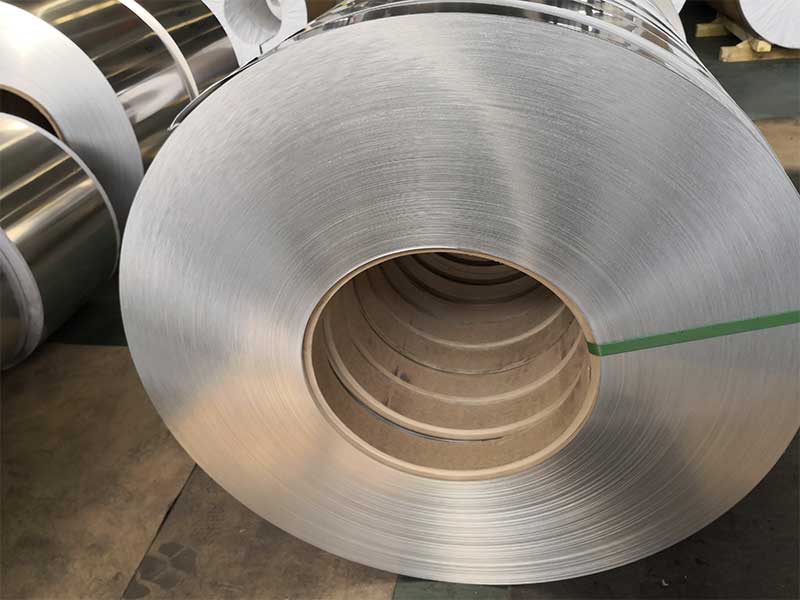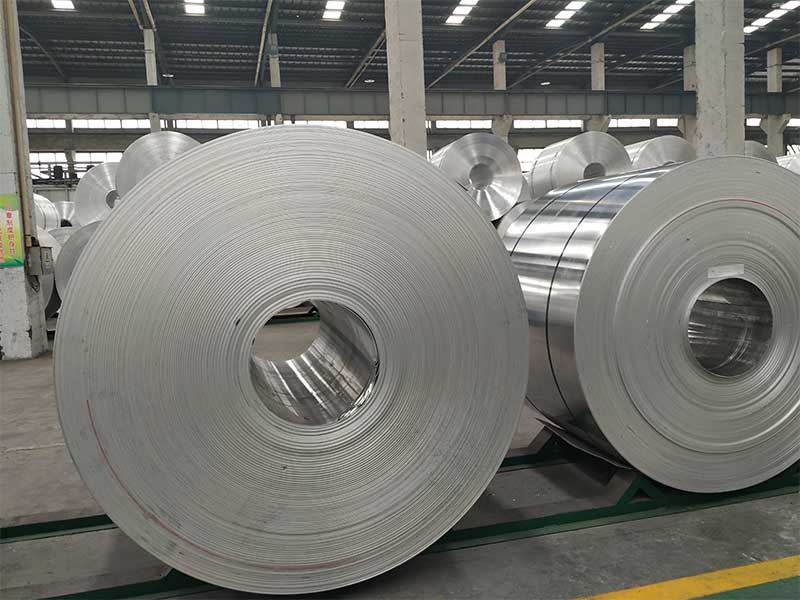

0.77mm 90mm Width Aluminum Coil
A 0.77mm thick, 90mm wide aluminum coil looks deceptively modest on paper. It isn't a "big coil" used for roofing sheets, nor a "micro-strip" for electronic foils. It sits in a sweet spot where thickness is substantial enough to hold shape and take forming loads, yet thin enough to move through high-speed stamping, roll forming, or slitting lines with low inertia and excellent thermal response. The 90mm width, meanwhile, is a quiet signal that this coil is often engineered for conversion efficiency: narrow enough to reduce trimming loss in small profiles and housings, wide enough to feed stable through progressive dies and compact roll-formers without edge wandering.
A useful way to understand this coil is to treat it not as a commodity dimension, but as a "process interface." Thickness and width are not just physical measures; they dictate what happens at the boundaries between metal and machine: where the strip meets the rolls, the die radii, the lubricants, the tension controllers, and the final product's tolerance stack.
Why 0.77mm matters more than you expect
At 0.77mm, aluminum strip begins to behave like a structural skin rather than a foil-like membrane. This matters in several practical ways.
The strip has enough section modulus to resist oil-canning and local buckling during handling and forming. In production, that translates into fewer dents, less waviness after levelling, and more stable punch penetration behavior. In end-use, it allows products such as covers, housings, trims, brackets, and protective channels to remain stiff without the weight penalty of thicker gauges.
0.77mm also lands in a thickness range where heat travels quickly through the material, so paint curing, adhesive bonding, and coil coating operations can be more efficient than with thicker plate. Yet it retains sufficient thermal mass to avoid the ultra-rapid temperature spikes that can sometimes create nonuniform aging effects in certain heat-treatable alloys if processing control is poor.
The quiet intelligence of 90mm width
A 90mm width is often chosen for manufacturing logic rather than aesthetics. It fits common slit patterns from master coils while minimizing scrap, and it is friendly to compact component geometries. Many plants design strips around the distance between guide rollers, the practical reach of small straighteners, and the feed width of servo-driven presses.
Narrower strips can reduce camber risk, but too narrow and edge quality dominates performance. At 90mm, edge condition remains critical yet manageable: slitting burr height, edge wave, and micro-cracking on the edge become the decisive factors in whether the strip will survive tight-bend flanges or deep drawn features.
From a quality-control perspective, 90mm is also a width that makes flatness measurement meaningful. You can quantify I-unit flatness, edge wave amplitude, and center buckle with enough lateral span to detect real shape issues, not just measurement noise.
Alloy selection through the lens of "what the strip must endure"
Instead of asking "what alloy is best," it's more productive to ask: what will this strip be forced to endure during conversion?
If the product is heavily formed, flanged, or bent tightly, non-heat-treatable alloys in the 3xxx or 5xxx series often excel because they deliver stable formability and good corrosion behavior without relying on post-forming heat treatment. If the part must hold threads, resist denting, or carry higher loads, heat-treatable 6xxx can be compelling, provided the temper and forming sequence are chosen carefully.
Typical alloy/temper choices for a 0.77mm × 90mm coil include:
- AA3003 H14/H24 for general forming, housings, trims, heat exchanger-related stampings where moderate strength and excellent workability are valued
- AA3105 H14 for painted architectural trims, channels, and light structural skins
- AA5052 H32 for marine-adjacent or high-corrosion environments and parts needing better fatigue and strength than 3xxx
- AA6061 T4 or AA6016/6111 in solution-treated form for stampings that will later be aged/paint-baked, balancing formability with final strength
Temper is not a footnote; it's the operating mode of the metal. H14 behaves predictably in bending but can crack if bend radii are too tight for the grain direction. H24 offers slightly different work-hardening balance and can help in some forming routes. For 5xxx alloys, H32 provides a reliable strength-formability compromise, while avoiding excessive work-hardening that can punish tight forming.
Technical details that actually drive performance
A coil like this succeeds or fails on details that rarely appear on a purchase order.
Surface finish governs downstream cosmetics and coating adhesion. A mill finish may be adequate for hidden structural parts, while a controlled bright finish can elevate visible trims. If coil coating or anodizing is planned, surface cleanliness and consistent oxide film behavior become essential.
Flatness and residual stress decide whether the strip feeds cleanly. Poor flatness leads to misfeeds, inconsistent draw-in, and accelerated tool wear. Residual stress can also cause "spring-open" after slitting or bending, making dimensional control a moving target.
Mechanical property uniformity across the width matters more at 90mm than at very wide sheets because small deviations in yield strength can translate into asymmetric forming and twist in narrow profiles. Tight control of rolling reduction and annealing (or controlled work-hardening) ensures the strip doesn't behave like two different materials from edge to edge.
Below is a practical reference table for common alloys used in thin-to-medium gauge strip applications. Values are typical ranges and vary by exact processing route and standard.
Typical chemical composition (wt. %) for common aluminum strip alloys
| Alloy | Si | Fe | Cu | Mn | Mg | Cr | Zn | Ti | Al |
|---|---|---|---|---|---|---|---|---|---|
| AA3003 | 0.60 max | 0.70 max | 0.05–0.20 | 1.0–1.5 | - | - | 0.10 max | - | Balance |
| AA3105 | 0.60 max | 0.70 max | 0.30 max | 0.30–0.80 | 0.20–0.80 | 0.20 max | 0.40 max | 0.10 max | Balance |
| AA5052 | 0.25 max | 0.40 max | 0.10 max | 0.10 max | 2.2–2.8 | 0.15–0.35 | 0.10 max | 0.10 max | Balance |
| AA6061 | 0.40–0.80 | 0.70 max | 0.15–0.40 | 0.15 max | 0.8–1.2 | 0.04–0.35 | 0.25 max | 0.15 max | Balance |
Implementation standards and what to specify
In procurement and inspection, it helps to anchor requirements to recognized standards rather than vague "good quality" language. Commonly referenced standards include ASTM B209 for aluminum and aluminum-alloy sheet and plate (often used as a baseline even for strip), ASTM B210/B221 for extrusions when strip is used as feedstock in hybrid processes, and EN 485 series for European supply chains covering tolerances and mechanical properties. For coil coating applications, EN 1396 and related coating specifications are often relevant depending on the system.
For a 0.77mm × 90mm coil intended for forming, critical callouts usually include thickness tolerance, slit width tolerance, camber limit, burr direction and maximum burr height, edge condition, surface class, and temper verification. If the coil will be anodized or used decoratively, specify surface quality on both sides and define allowable defects in practical terms such as "no linear scratches visible at X distance under Y lighting," because that aligns inspection with real-world acceptance.
Applications where this coil quietly dominates
This size frequently appears in roll-formed trims and channels, appliance and equipment covers, lighting and reflector substructures, cable management components, HVAC shrouds, battery and electronics housings, and protective edging. It is also common in stamped brackets, shields, and cosmetic bands where the strip must form cleanly and remain dimensionally stable.
In painted systems, 3105 or 3003 in suitable tempers can deliver dependable adhesion and consistent color appearance. In corrosion-sensitive environments, 5052 is a workhorse, especially when combined with appropriate pretreatment and coating. For parts that need a strength boost after forming, 6xxx in a formable temper followed by paint-bake aging can offer an elegant route, provided forming limits and springback are managed.
A distinctive way to think about it: "precision bandwidth"
A 0.77mm 90mm aluminum coil is best seen as precision bandwidth: a narrow corridor where manufacturability, stiffness, surface quality, and cost converge. It's not merely a strip of metal; it's a tuned input to a production ecosystem. When the alloy and temper match the forming route, when flatness and edges are controlled, and when standards-based tolerances are specified with intent, this coil becomes one of the most efficient ways to turn aluminum's intrinsic advantages into repeatable, high-volume parts.
https://www.al-alloy.com/a/077mm-90mm-width-aluminum-coil.html