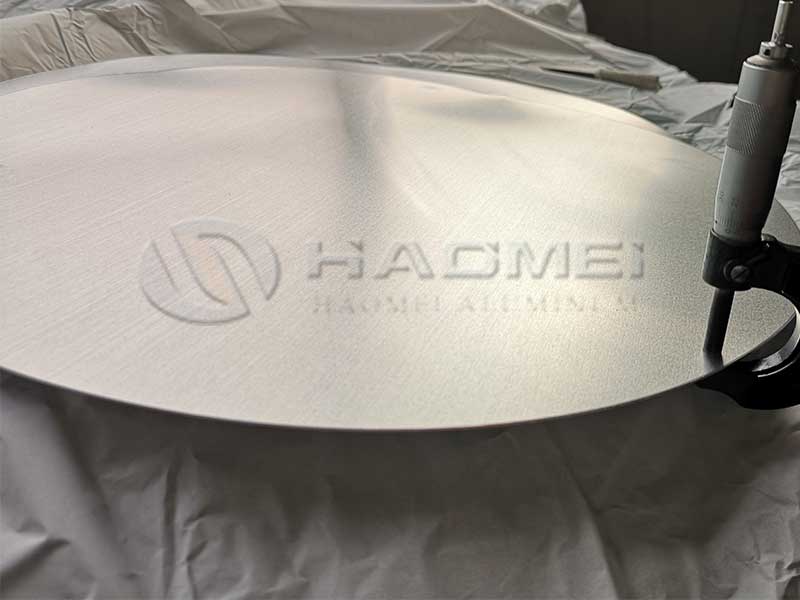

Alloy 1100 1200 H12 H14 Aluminum disk for cookware
Aluminum disks (also called circles or blanks) made from Alloy 1100 / Alloy 1200 in H12 and H14 tempers are a workhorse material for modern cookware. They offer a balanced combination of excellent formability, high thermal conductivity, low weight, and clean food-contact performance, making them ideal for deep drawing, spinning, stamping, and impact forming into pots, pans, lids, kettles, and pressure-cooker components.
1) What the Product Is
Product: Aluminum disk (circle/blank) for cookware
Base alloys: AA 1100 and AA 1200 (commercially pure aluminum series)
Tempers: H12 (¼-hard) and H14 (½-hard)
Main forming routes: Deep drawing, metal spinning, stamping, forging/impact forming (depending on thickness and design)
Why these alloys?
1100/1200 are known for high purity aluminum, which brings:
- Excellent ductility (drawability and spinability)
- Very good corrosion resistance
- High thermal conductivity for even heating
- Bright surface potential (polishing, anodizing, coating)
2) Features at a Glance
| Feature | What it Means in Production | Customer Benefit |
|---|---|---|
| High formability (1100/1200) | Stable deep drawing & spinning with low cracking risk | Enables complex shapes and thin walls |
| H12 / H14 temper options | Tuned strength vs. ductility | Better dimensional stability and dent resistance |
| High thermal conductivity | Fast heat transfer across the cookware base | More uniform cooking, less hot-spotting |
| Excellent corrosion resistance | Strong resistance to kitchen moisture and mild chemicals | Longer service life, easier cleaning |
| Smooth, clean surface | Good compatibility with polishing, anodizing, coating | Attractive appearance and reliable finishing |
| Low density | Lightweight cookware | Better handling and lower shipping cost |
Both are "commercially pure" aluminum alloys. In practice:
- AA1100 is widely used and highly standardized for cookware circles.
- AA1200 typically has slightly higher minimum aluminum content (varies by standard), often selected when customers prioritize purity-driven formability and finish consistency.
Selection guideline:
- Choose 1100 for broad availability and excellent overall balance.
- Choose 1200 when emphasizing purity and consistent surface/finishing behavior in high-volume cookware programs.
4) Temper Meaning: H12 vs H14 (Why It Matters)
Work-hardening tempers influence how the disk behaves during forming and in the final product.
| Temper | Typical Work-Hardening Level | Forming Behavior | Best Fit Use Cases |
|---|---|---|---|
| H12 | ~¼-hard | Higher ductility; easier deep drawing/spinning | Deep drawn pots, kettles, parts with tight radii |
| H14 | ~½-hard | Higher strength; better shape retention | Pan bases, lids, shallow draws, parts needing stiffness |
Practical takeaway:
If your part is deep and requires aggressive forming, start with H12. If your part is shallow but needs better dent resistance, consider H14.
5) Chemical Composition (Typical Limits)
Actual limits depend on the governing standard (ASTM/EN/JIS) and mill certification. The table below reflects commonly referenced composition ranges for AA1100 and AA1200.
Chemical Composition Table (wt.%)
| Alloy | Al (min) | Si + Fe (max) | Cu (max) | Mn (max) | Zn (max) | Others (each) | Others (total) |
|---|---|---|---|---|---|---|---|
| AA1100 | 99.00 | 1.00 | 0.20 | 0.05 | 0.10 | 0.05 | 0.15 |
| AA1200 | 99.00–99.20* | 1.00 | 0.05–0.10* | 0.05 | 0.10 | 0.05 | 0.15 |
*Exact values vary by specification and supplier practice; use mill test certificate (MTC) for contractual compliance.
6) Mechanical Properties (Typical Values)
Mechanical properties vary with thickness, processing route, and coil/disc production practice. Use the values below as practical reference for cookware forming.
Mechanical Property Table (Typical)
| Alloy / Temper | Tensile Strength (MPa) | Yield Strength (MPa) | Elongation A50 (%) | Notes |
|---|---|---|---|---|
| 1100-H12 | 95–120 | 60–95 | 10–20 | Excellent drawability with moderate stiffness |
| 1100-H14 | 110–145 | 80–120 | 4–12 | Better dent resistance; less stretch than H12 |
| 1200-H12 | 90–120 | 55–90 | 12–22 | Often chosen for consistent forming response |
| 1200-H14 | 105–140 | 75–115 | 5–12 | Good rigidity for lids and shallow parts |
7) Technical Specifications (Cookware Disk / Circle)
Below is a concise specification template commonly used for cookware disk supply. Final ranges should match your drawing and forming process window.
Dimensional & Surface Specifications
| Item | Typical Range / Option | Why It Matters |
|---|---|---|
| Diameter | 80–1200 mm (custom) | Matches pot/pan size and trimming allowance |
| Thickness | 0.4–6.0 mm (common cookware range) | Controls strength, heat spreading, weight |
| Temper | H12 / H14 (also O possible by request) | Balances formability vs stiffness |
| Edge | Deburred / smooth edge | Reduces tool wear and edge cracking |
| Surface finish | Mill finish / brushed / bright | Impacts coating, anodizing, aesthetics |
| Flatness | Controlled for stamping | Prevents misfeeds and uneven draw |
| Grain control | Fine, uniform grain preferred | Improves deep drawing and reduces "earing" |
| Packaging | Interleaved paper/film + pallet | Prevents scratches and oxidation staining |
8) Performance in Cookware Manufacturing
8.1 Deep Drawing & Spinning Performance
1100/1200 disks are favored because they tolerate high plastic deformation. When paired with correct lubrication and die radius design, they help achieve:
- Reduced risk of orange peel (with proper grain control)
- Lower probability of rim cracking
- More stable wall thickness distribution in deep draws
Process hint: If you see edge splits on deep parts, switching from H14 → H12 (or reducing work-hardening) often improves success without changing tooling.
8.2 Thermal Performance
High-purity aluminum alloys are excellent heat conductors, meaning:
- Faster heating response
- More uniform base temperature
- Better compatibility with multi-step cookware designs (e.g., anodized bodies, coated surfaces)
8.3 Corrosion & Food-Contact Behavior
These alloys naturally form an aluminum oxide film that protects against corrosion in typical kitchen environments. They also serve as a strong substrate for:
- Anodizing (hard, wear-resistant surface)
- Non-stick coatings (PTFE/ceramic systems)
- Polishing and decorative finishing
9) Typical Applications (Where These Disks Shine)
| Cookware Category | Recommended Alloy/Temper | Reason |
|---|---|---|
| Deep-drawn pots, milk pans, kettles | 1100/1200 H12 | Maximum drawability and low cracking risk |
| Spun wok bodies | 1100/1200 H12 | Smooth spinning, good rim forming |
| Frying pan bodies (shallow draw) | 1100 H14 | Better stiffness and dent resistance |
| Lids and covers | 1100/1200 H14 | Flatness retention and rigidity |
| Anodized cookware | 1200 (H12/H14) | Consistent surface and finishing response |
| Coated cookware substrate | 1100/1200 | Strong adhesion base after pretreatment |
- Higher forming yield: fewer cracks, fewer rejects, smoother production runs
- Better cooking experience: uniform heating and responsive temperature control
- Premium look & finish: supports polished, anodized, and coated appearances
- Lightweight durability: strength-to-weight advantage for daily handling
- Flexible selection: H12 for forming depth, H14 for stiffness and dent resistance
11) Quick Selection Guide
| If your priority is… | Choose |
|---|---|
| Maximum deep draw/spin capability | 1200-H12 or 1100-H12 |
| Better stiffness and dent resistance | 1100-H14 or 1200-H14 |
| Strong supply availability and broad acceptance | 1100 (H12/H14) |
| Finishing consistency for anodizing/coating | 1200 (H12/H14) |
Final Note
For best results, specify your disk with diameter, thickness, temper, surface finish requirement, edge condition, and any critical forming process notes (deep draw ratio, spinning, anodizing/coating). With the right pairing of 1100/1200 and H12/H14, aluminum disks become a reliable, scalable foundation for high-performance cookware.
https://www.al-alloy.com/a/alloy-1100-1200-h12-h14-aluminum-disk-for-cookware.html