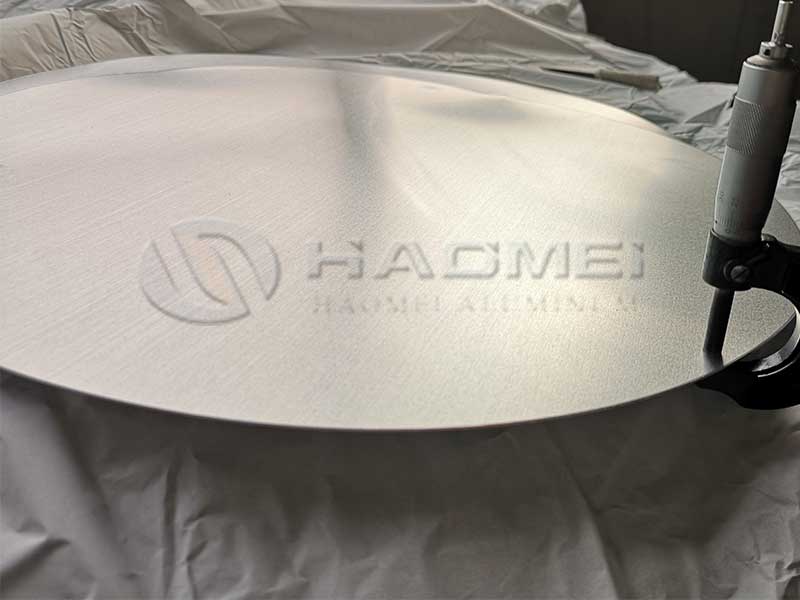

Aluminum Coil 3003 DC CC for pressure cookware making
Pressure cookware is a curious product: it must feel friendly and domestic, yet it operates like a tightly managed engineering vessel. A lid locks, steam builds, temperature rises, and every square centimeter of the pot quietly negotiates stress, heat, and repeated kitchen abuse. When you look at it from that angle, choosing an aluminum coil is less about "buying metal" and more about selecting the behavior of a material over thousands of heating cycles. From that perspective, Aluminum Coil 3003-whether supplied as DC or CC-earns its place not because it is exotic, but because it is predictably cooperative.
Why 3003 behaves like a cookware alloy should
Alloy 3003 belongs to the Al-Mn family. Manganese is the subtle ingredient that gives 3003 its personality: better strength than pure aluminum, good ductility, stable corrosion performance in common cooking environments, and excellent forming response. In pressure cookware, the body and lid (depending on design) are usually deep drawn or spun, then trimmed, pierced, rolled, and sometimes anodized or coated. That sequence rewards an alloy that can stretch without tearing, resist "orange peel" surface issues, and tolerate work hardening while still allowing controlled annealing.
3003 also holds up well in daily realities: mild acids, salts, detergents, and the occasional forgotten pot soaking in a sink. It is not a "high strength" alloy, but pressure cookware does not demand aircraft-level yield strength; it demands a balance of formability, uniform thickness after forming, consistent grain structure, and reliable joining or finishing. 3003 is strong where it matters and forgiving where it counts.
DC vs CC: two routes to the same kitchen, with different footprints
The DC/CC conversation is often treated like a purchasing checkbox. For pressure cookware, it is better understood as a question of texture, grain structure, thickness capability, and forming stability.
DC, or Direct Chill casting followed by hot rolling and cold rolling, is the traditional pathway for quality cookware stock-especially when deeper drawing performance and thickness uniformity are priorities. DC material tends to offer more controllable metallurgical structure for demanding forming operations, and it is widely favored when customers want consistent earing behavior and predictable anisotropy in deep drawn parts.
CC, or Continuous Casting, is efficient and cost-effective, with shorter production routes and attractive economics for high-volume applications. With modern process controls, CC 3003 can perform well in many cookware forming operations, particularly in medium draw depths, where the design allows adequate radii and the forming line is tuned for the material's directional characteristics. CC can be an excellent choice when the design is optimized, thickness is within a stable range for the caster, and the maker values throughput and competitiveness.
The distinctive way to think about DC and CC for pressure cookware is this: DC is often chosen to reduce surprises during forming; CC is often chosen to reduce surprises in cost and supply continuity. Either can work, but the product design and forming route should "speak the same language" as the coil.
Temper selection: the quiet controller of drawability and stability
Pressure cookware components often require both deep drawability and enough stiffness to keep shape during assembly and service. That means temper selection is not a trivial specification line.
Soft tempers such as O (fully annealed) are typically used where maximum formability is required, such as deep drawn bodies. H14 or H24 may be selected for parts that need better rigidity or dent resistance, provided the forming severity is moderate or the operation is staged with intermediate annealing. In many cookware plants, the practical solution is to use O temper for deep draw stages and rely on controlled work hardening introduced by forming and subsequent operations to achieve final stiffness.
For coils used in pressure cookware, consistency across the width and along the length matters as much as the nominal temper. A coil that drifts in hardness can form beautifully at the head and tear near the tail. This is why reputable suppliers document mechanical properties, hardness windows, and coil-to-coil repeatability.
Practical implementation standards and what they mean on the shop floor
When specifying aluminum coil 3003 for cookware, common reference standards include ASTM B209 for aluminum and aluminum-alloy sheet and plate. Many cookware supply chains also align with EN 485 (mechanical properties and tolerances) in markets that use European norms. For chemical composition, AA/ASTM limits are typically used.
The standards are not just paperwork; they influence what the factory can trust. Thickness tolerance affects weight control and heat response. Flatness affects blanking and lubrication behavior. Surface quality affects anodizing appearance and non-stick coating adhesion. Edge quality affects feeding stability on stamping lines and reduces the risk of edge cracks during drawing.
Surface and cleanliness: cookware is a finishing-driven product
Pressure cookware often receives coatings, anodizing, polishing, or brushing. Those finishes magnify small surface inconsistencies. For coil stock, this means attention to:
Surface class appropriate for cookware, with controlled roll marks and minimal inclusions
Low residual rolling oil, compatible with the plant's degreasing process
Stable surface energy for coatings, especially for PTFE or ceramic systems
Uniform grain size to reduce visual streaking after anodizing
In practical terms, a slightly more expensive coil that reduces coating rejects can be far cheaper than a coil that saves money upfront but creates finishing losses.
Typical processing route and where 3003 helps
A common route for a pressure cooker body begins with blanking, then deep drawing or spinning, followed by trimming, beading, and sometimes bottom forming for induction base attachment. 3003's work hardening curve supports staged forming: it hardens enough to maintain shape yet can be annealed when needed. It also welds and brazes well in many cookware constructions, particularly when combined with compatible filler and proper cleaning.
If an induction base is added, it is usually stainless bonded to aluminum via impact bonding, brazing, or other composite methods. In such designs, the aluminum layer must remain dimensionally reliable through heat cycles. 3003's thermal conductivity and stability make it a solid candidate for heat distribution, though the exact base design will determine performance.
Chemical composition and properties: a practical reference
Below is a commonly referenced chemical composition range for AA 3003, aligned with typical AA/ASTM limits. Actual mill certificates should be used for acceptance.
AA 3003 Chemical Composition (wt.%)
| Element | Si | Fe | Cu | Mn | Zn | Others (each) | Others (total) | Al |
|---|---|---|---|---|---|---|---|---|
| Limit | ≤0.60 | ≤0.70 | 0.05–0.20 | 1.0–1.5 | ≤0.10 | ≤0.05 | ≤0.15 | Balance |
Mechanical properties depend on thickness, temper, and applicable standard. The values below are typical for sheet/coil and serve as practical guidance rather than guaranteed limits.
Typical Mechanical Properties for AA 3003
| Temper | Tensile Strength (MPa) | Yield Strength (MPa) | Elongation (%) |
|---|---|---|---|
| O | 90–130 | ≥35 | 25–35 |
| H14 | 140–180 | ≥115 | 4–10 |
| H24 | 140–180 | ≥105 | 8–14 |
For pressure cookware, the elongation and uniformity of elongation often matter more than peak strength numbers, because failure risk is usually tied to tearing during forming rather than collapse in service.
Selecting coil parameters that match pressure cookware reality
In real purchasing decisions, the most useful parameters are thickness, width, temper, surface condition, and coil ID/OD matching the plant's decoiler. Thickness commonly falls in ranges used for deep drawn cookware bodies, and the final choice should reflect the pot diameter, draw depth, and whether the design includes reinforcement features such as beads or rolled rims.
Just as important is the coil's anisotropy behavior, which drives earing. Earing increases trimming loss and can reduce throughput. DC material is often selected when earing control is critical, though well-made CC coil can also be managed with die tuning and optimized blank shapes.
A final viewpoint: "pressure cookware metal" is really process metal
Thinking from the cookware maker's perspective, 3003 DC or CC is not selected for its datasheet alone; it is selected for how it behaves in the forming line, cleaning line, and finishing line. The winning coil is the one that keeps a steady rhythm: predictable drawing, stable surface, consistent hardness, low scrap, and reliable delivery.
In that sense, Aluminum Coil 3003-DC for deeper forming confidence, CC for efficient mass production-acts less like a commodity and more like a process partner. When the coil matches the factory's forming personality, the pressure cooker becomes what it should be: a safe, durable vessel that quietly turns metallurgy into everyday meals.
https://www.al-alloy.com/a/aluminum-coil-3003-dc-cc-for-pressure-cookware-making.html