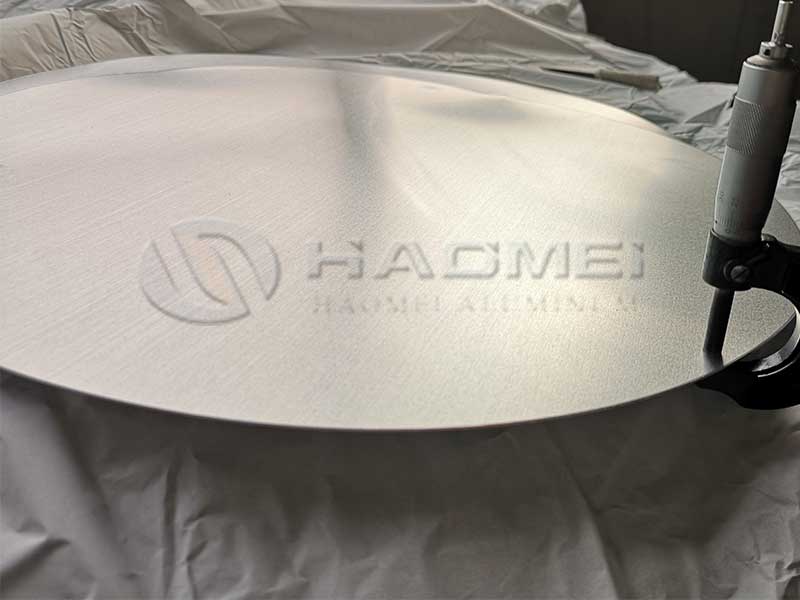

1050 1070 3003 aluminium circle alloy
1050, 1070, and 3003 aluminium circle alloy products are precision-cut round blanks designed for high-efficiency forming, deep drawing, and spinning. They are widely used to manufacture cookware, lighting reflectors, traffic signs, nameplates, and many other circular components where consistent thickness, clean edges, and stable mechanical performance are essential.
These aluminium circles combine excellent surface quality, tight dimensional control, and reliable alloy/temper options to fit both decorative and heavy-forming applications. Choosing between 1050, 1070, and 3003 typically depends on the target balance of conductivity, reflectivity, formability, and strength.
What makes 1050 / 1070 / 3003 aluminium circles different
1050 aluminium circles are known for high purity, strong corrosion resistance, and excellent workability-ideal for general deep drawing and cost-effective production.
1070 aluminium circles offer even higher purity than 1050, making them a preferred option for applications needing higher electrical/thermal conductivity or high reflectance surfaces.
3003 aluminium circles are an Al-Mn alloy with higher strength than 1xxx series while retaining very good forming behavior, making them a strong choice for cookware and parts requiring better dent resistance and rigidity.
features customers care about
| Feature | What it means in production | Customer benefit |
|---|---|---|
| Excellent deep drawing and spinning performance | Stable grain structure, controlled hardness, consistent thickness | Fewer cracks, wrinkles, and earing during forming |
| Clean, burr-controlled edges | Proper slitting/punching or CNC blanking; deburred edge control | Safer handling, better tool life, smoother draw |
| High surface quality | Low defect surface, controlled oil/film, clean finish | Better anodizing/painting, improved appearance |
| Tight gauge tolerance | Stable rolling and inspection | Consistent finished weight and uniform forming |
| Alloy/temper flexibility | O, H12/H14, H24 options commonly available | Works for soft deep draw or stronger finished parts |
| Corrosion resistance | Natural oxide layer, clean chemistry | Longer service life in kitchens/outdoors |
Typical applications
| Industry / Use | Recommended alloy | Why it fits |
|---|---|---|
| Cookware (pots, pans, lids, pressure cooker parts) | 3003-O, 1050-O | Strong forming ability; 3003 improves strength and dent resistance |
| Lighting reflectors, lamp shades | 1070, 1050 | High reflectivity potential; good surface finish |
| Traffic signs, nameplates, labels | 1050, 1070 | Excellent corrosion resistance; good printing/anodizing base |
| Heat-related components (some reflectors, diffusion plates) | 1070 | Higher thermal conductivity than 1050/3003 |
| General deep drawn shells and covers | 1050-O, 3003-O | Stable draw quality and low forming scrap |
Alloy temper options and forming behavior
| Alloy | Common tempers for circles | Forming notes | Typical selection logic |
|---|---|---|---|
| 1050 | O, H12, H14 | O temper is best for deep draw; H temp for stiffer parts | Choose O for heavy drawing; H14 for flatter, stronger blanks |
| 1070 | O, H12, H14 | Soft temper supports deep drawing; high purity supports reflectivity | Choose when conductivity/reflectivity matters |
| 3003 | O, H14, H24 | O temper draws well; H temp improves rigidity | Choose for cookware needing better strength than 1xxx |
Chemical composition (typical limits)
Values below reflect common reference ranges used in purchasing and inspection. Actual limits depend on the governing standard and mill practice.
| Element | 1050 (%) | 1070 (%) | 3003 (%) |
|---|---|---|---|
| Al (min) | 99.50 | 99.70 | Remainder |
| Si | ≤ 0.25 | ≤ 0.20 | ≤ 0.60 |
| Fe | ≤ 0.40 | ≤ 0.25 | ≤ 0.70 |
| Cu | ≤ 0.05 | ≤ 0.04 | 0.05–0.20 |
| Mn | ≤ 0.05 | ≤ 0.03 | 1.0–1.5 |
| Mg | ≤ 0.05 | ≤ 0.03 | ≤ 0.05 |
| Zn | ≤ 0.05 | ≤ 0.04 | ≤ 0.10 |
| Ti | ≤ 0.03 | ≤ 0.03 | ≤ 0.10 |
| Others (each) | ≤ 0.03 | ≤ 0.03 | ≤ 0.05 |
Mechanical performance snapshot (typical, by temper)
Mechanical properties vary with thickness and exact process route. The table below is a practical comparison for product selection.
| Alloy / Temper | Relative strength | Relative formability | Typical use in circles |
|---|---|---|---|
| 1050-O | Low | Excellent | Deep drawn cookware, soft forming parts |
| 1050-H14 | Medium | Good | Stiffer discs, signage, general stamping |
| 1070-O | Low | Excellent | High reflectance parts, conductive components |
| 3003-O | Low–medium | Excellent | Deep drawn pots/pans, complex draws |
| 3003-H14 / H24 | Medium | Good | Lids, covers, parts needing rigidity |
Technical specifications (manufacturing-ready)
Specifications can be customized, but the following ranges are common in mass production for cookware and industrial stamping.
| Item | Typical range / option |
|---|---|
| Alloy | 1050 / 1070 / 3003 |
| Temper | O, H12, H14, H24 (as agreed) |
| Diameter | 80–1200 mm (customizable) |
| Thickness | 0.3–6.0 mm (common cookware: 0.6–4.0 mm) |
| Diameter tolerance | As agreed; tight control available for automated lines |
| Thickness tolerance | As agreed; controlled by coil/plate rolling capability |
| Edge quality | Burr-controlled, smooth edge, deburred option |
| Surface finish | Mill finish; surface protected packaging optional |
| Processing route | DC casting + hot/cold rolling + blanking/punching |
| Packaging | Wooden pallet/box, interleaving paper/film, moisture protection |
Quality control points that reduce forming scrap
| Control item | Why it matters for circles | Typical customer gain |
|---|---|---|
| Grain and texture control | Influences earing and draw stability | More uniform draw, less trimming loss |
| Flatness and residual stress | Affects feeding and die alignment | Fewer jams and shape defects |
| Edge burr management | Burrs can start cracks during draw | Longer die life, improved safety |
| Consistent hardness | Prevents unpredictable forming behavior | Stable production output |
Selection guidance for fast purchasing decisions
| If your priority is… | Choose… | Notes |
|---|---|---|
| Lowest cost with excellent draw | 1050-O | Strong all-round choice for cookware blanks |
| Higher reflectivity / conductivity | 1070-O | Ideal for reflectors and conductive uses |
| Better strength while keeping good formability | 3003-O or 3003-H14 | Popular for durable cookware and housings |
1050 1070 3003 aluminium circle alloy products are high-quality round aluminium blanks engineered for deep drawing, spinning, and stamping. 1050 and 1070 offer high purity, corrosion resistance, and excellent formability, with 1070 delivering higher conductivity and reflectance. 3003 aluminium circles provide improved strength and dent resistance thanks to manganese addition, making them ideal for cookware and formed components. Available in common tempers such as O, H12, H14, and H24, these aluminium circles feature clean edges, consistent thickness, and dependable surface quality for efficient mass production in cookware, lighting reflectors, signage, and industrial applications.
https://www.al-alloy.com/a/1050-1070-3003-aluminium-circle-alloy.html