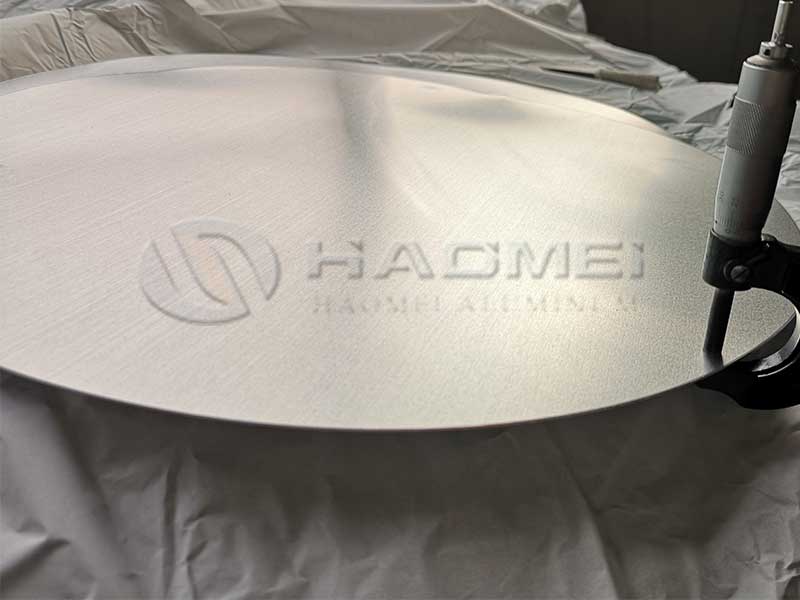

1060 1050 1100 HO Aluminum Circle disc for kitchen utensils making use
1060 1050 1100 H0 Aluminum Circle Disc for Kitchen Utensils Making: A Material That "Behaves" Well Under Heat and Pressure
In kitchenware manufacturing, the aluminum circle is not just a cut-to-size blank. It is the starting point of a shaping journey where metal must flow smoothly, stay clean, resist cracking, and still look good after polishing, anodizing, or coating. That is why 1050, 1060, and 1100 H0 aluminum circle discs remain the quiet workhorses behind everyday utensils: cookware bottoms, pots, pans, lids, pressure cooker components, mixing bowls, kettle parts, and even small appliance shells.
From a practical perspective, these alloys are chosen less for "strength" and more for how predictably they form. In utensil production, the best material is the one that cooperates with spinning, deep drawing, stamping, and impact forming, while keeping scrap low and surface quality high.
Why 1050/1060/1100 H0 Works So Well for Utensils
H0 (O temper) is the behavior. H0 means fully annealed-soft, ductile, and forgiving. When a disc is deep drawn into a pot body or spun into a bowl, the metal must stretch without tearing. H0 aluminum circles allow high drawing ratios, stable wall thickness distribution, and reduced "earing" tendency (wavy rim defects caused by anisotropy).
High purity brings high conductivity. 1050, 1060, and 1100 are all in the 1xxx series, known for high aluminum content. That purity translates into excellent thermal conductivity, which supports even heating in cookware and improved energy efficiency. It also improves corrosion resistance for daily kitchen exposure.
Surface is not a cosmetic detail-it's process insurance. Kitchen utensil circles are often required to be free of oil stains, roll marks, edge burrs, and black spots. A clean surface reduces tool wear, avoids coating defects, and improves anodizing consistency. For non-stick cookware, a stable surface helps coatings adhere more uniformly.
Distinctive Viewpoint: "Flow Quality" Matters More Than "Hardness"
Many buyers compare alloys based on mechanical strength, but utensil manufacturing rewards controlled metal flow. During deep drawing and spinning, the disc experiences complex stress paths. The 1xxx H0 alloys offer:
- Low yield strength for easier forming and lower press load
- High elongation for stretchability
- Reduced risk of orange peel texture when finished properly
- Good compatibility with subsequent processes like anodizing, polishing, and non-stick coating
In short, these discs are selected because they behave predictably under deformation-like a material designed to be shaped, not forced.
Typical Applications in Kitchen Utensils
1060/1050/1100 H0 aluminum circle discs are widely used for:
- Deep drawn cookware: stockpots, milk pots, saucepans, steamer bodies
- Spinning products: mixing bowls, lids, kettle shells, lamp-like utensil forms
- Stamped components: induction base carriers (when combined with other layers), small lids, trays
- Pressure cookware accessories: inner liners, covers (design-dependent)
- Surface-finished utensils: anodized cookware, polished kitchenware, coated non-stick pans
Where the forming is more demanding, manufacturers often lean toward 1060 because its higher purity can support better ductility and surface consistency. 1100 is popular for forming and finishing balance. 1050 is often chosen for cost-effective, high-volume cookware where excellent forming is still required.
Parameters Customers Commonly Specify
For utensil-grade aluminum circles, purchasing parameters are usually defined around forming performance, dimensional accuracy, and surface quality.
Typical supply range (common market capability)
- Alloy: 1050 / 1060 / 1100
- Temper: H0 (O, annealed)
- Thickness: 0.3–6.0 mm (common cookware range often 0.8–4.0 mm)
- Diameter: 80–1200 mm (custom sizes possible)
- Inside quality: clean surface, no oil, no heavy scratches, controlled edge burr
- Flatness: suitable for drawing/spinning, minimal waviness
- Edge condition: smooth trimmed or deburred edge to protect tooling
Because utensil factories measure success in production yield, many buyers also request Earing control, grain uniformity, and consistent mechanical properties lot-to-lot.
Implementation Standards and Common Inspection References
Aluminum circles for cookware are typically produced from rolled sheet/coil and blanked. Standards used in trade and inspection commonly include:
- ASTM B209: Aluminum and Aluminum-Alloy Sheet and Plate
- EN 485: Aluminum and aluminum alloys-sheet, strip and plate (mechanical properties and tolerances)
- GB/T 3880: Aluminum and aluminum alloy plates and strips (widely referenced in China supply chains)
- RoHS / REACH compliance may be requested for cookware and consumer goods supply
In addition to standard compliance, utensil manufacturers often impose internal requirements for surface cleanliness, coating suitability, and drawing performance that go beyond basic sheet tolerances.
Alloy and Tempering Conditions Explained Simply
1050 / 1060 / 1100 belong to nearly pure aluminum alloys, where the main differentiator is aluminum content and trace elements.
H0 / O temper indicates the disc has been annealed to maximize ductility. For kitchen utensils, this temper helps reduce cracking during deep drawing and spinning and supports consistent finishing quality. If a manufacturer needs slightly higher hardness for specific designs, other tempers may be used, but H0 is the classic choice for complex forming.
Chemical Composition Table (Typical Limits)
Below is a commonly referenced chemistry range for these alloys. Exact limits can vary by standard version and supplier control, so final values should follow the agreed standard and mill test certificate.
| Alloy | Al (min) | Si (max) | Fe (max) | Cu (max) | Mn (max) | Mg (max) | Zn (max) | Ti (max) |
|---|---|---|---|---|---|---|---|---|
| 1050 | 99.50% | 0.25% | 0.40% | 0.05% | 0.05% | 0.05% | 0.05% | 0.03% |
| 1060 | 99.60% | 0.25% | 0.35% | 0.05% | 0.03% | 0.03% | 0.05% | 0.03% |
| 1100 | 99.00% | 0.95% (Si+Fe) | included in (Si+Fe) | 0.05–0.20% | 0.05% | - | 0.10% | - |
For utensil manufacturing, the practical takeaway is that higher purity generally supports better conductivity and forming consistency, while controlled Fe/Si helps maintain stable rolling and forming behavior.
Functional Properties for Kitchenware Use
Thermal performance
High-purity aluminum transfers heat quickly and evenly, improving cooking response and reducing hot spots in many cookware designs.
Corrosion resistance
1xxx alloys naturally form a stable oxide layer, giving good resistance in typical kitchen environments. Surface treatments such as anodizing or coating further enhance durability and cleanability.
Finish friendliness
These discs accept polishing, anodizing, and coating well when surface cleanliness is controlled. For non-stick applications, consistent roughness and cleanliness can improve coating adhesion stability.
Manufacturing efficiency
Smooth forming means less tool damage, fewer rejects, fewer edge splits, and better throughput-often the most valuable "property" in a cookware factory.
What to Confirm When Buying Aluminum Circle Discs
A good utensil-grade aluminum circle is defined not only by alloy and temper, but by how it performs on the line. Buyers typically confirm:
- H0 annealing quality and stable mechanical behavior
- Surface free from oil, oxidation spots, and deep scratches
- Tight diameter tolerance and roundness for consistent die alignment
- Low burr edges to protect tooling and avoid crack initiation
- Suitable grain structure for drawing/spinning and low earing
Closing Thought
1060, 1050, and 1100 H0 aluminum circle discs succeed in kitchen utensils because they offer the rare combination manufacturers want most: metal that forms calmly, heats evenly, and finishes cleanly. In cookware production, that predictable "flow quality" is what turns a simple round disc into a reliable pot, pan, lid, or bowl that performs every day in real kitchens.