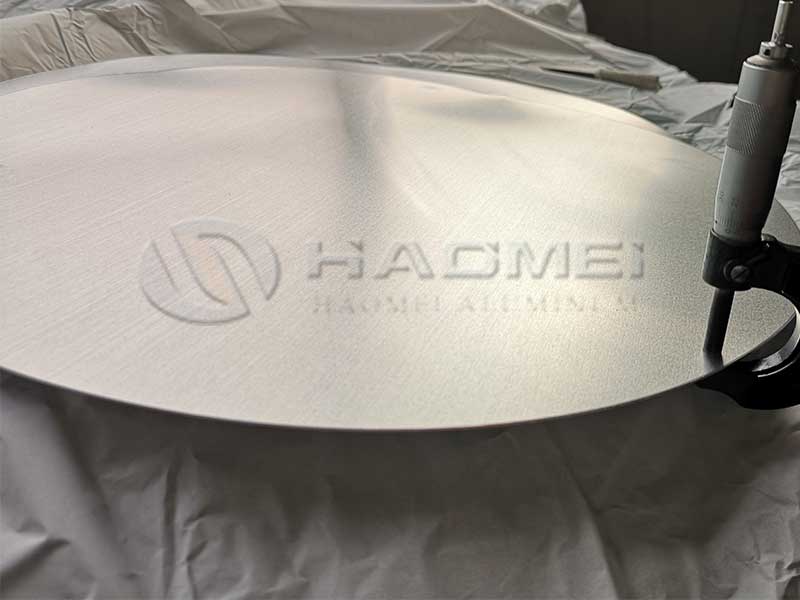

CC DC Aluminum Sheet Circle for Kitchenware
CC/DC aluminum sheet circles are the quiet workhorses behind everyday cookware: frying pans, pressure cooker bodies, rice-cooker liners, steamer plates, kettles, and lids. Produced as round blanks cut from aluminum coil or plate, these circles are engineered to stamp, spin, deep-draw, and anodize with high yield and clean appearance. For kitchenware makers, the right circle is less about "just aluminum" and more about stable forming, consistent thickness, surface cleanliness, and predictable thermal performance.
What "CC" and "DC" Mean in Kitchenware Circles
CC (Continuous Cast) circles are cut from continuously cast coil. They are valued for cost-efficiency, steady supply, and suitability for common cookware that requires moderate forming and reliable heat transfer.
DC (Direct Chill Cast) circles are made from DC-cast ingot that is hot/cold rolled into sheet or coil, then blanked into circles. DC material is favored when demanding forming is required-especially deep drawing, spinning, and high-end anodized finishes-because of its typically finer, more uniform structure and enhanced formability.
Features That Matter to Cookware Manufacturers
Formability tailored to stamping, spinning, and deep drawing
Kitchenware shapes often combine flat areas, tight radii, and tall walls. Well-controlled temper and grain structure reduce risks of earing, wrinkling, tearing, and orange peel. DC circles are commonly chosen for deeper draw ratios and premium appearance, while CC circles perform strongly in mainstream cookware with optimized process windows.
Excellent thermal conductivity for fast, even heating
Aluminum's high thermal conductivity supports rapid heat-up and uniform temperature distribution, helping reduce hot spots-especially important for frying pans and sauté pans.
Surface quality for coating and anodizing
Circles intended for non-stick coatings, enamel systems, or anodizing must be clean, smooth, and defect-controlled. Typical supply includes degreased and brush-finished or mill-finished surfaces, with strict limits on scratches, pits, and inclusions.
Tight thickness control for stable forming and consistent weight
Uniform thickness improves draw consistency, reduces thinning at corners, and keeps finished cookware weights predictable-an important factor for both performance and packaging/shipping.
Food-contact compatibility (with correct finishing)
Aluminum circles are routinely used for food-contact products when processed under applicable regulations and coated/anodized as required by the end market. Final compliance depends on the customer's coating system, anodizing parameters, and hygiene controls.
Typical Alloy Options for Kitchenware Circles
The most common alloys for cookware circles fall within the 1xxx and 3xxx series.
Chemical Composition (Typical)
| Alloy | Si (max) | Fe (max) | Cu (max) | Mn | Mg (max) | Zn (max) | Al (min) | Notes for Kitchenware |
|---|---|---|---|---|---|---|---|---|
| 1050 | 0.25 | 0.40 | 0.05 | 0.05 | 0.05 | 0.05 | 99.50 | High conductivity, good spinning, common for lids and general cookware |
| 1060 | 0.25 | 0.35 | 0.05 | 0.03 | 0.03 | 0.05 | 99.60 | Very good formability and surface, frequent choice for anodized kitchenware |
| 1070 | 0.20 | 0.25 | 0.04 | 0.03 | 0.03 | 0.04 | 99.70 | Premium purity, excellent anodizing brightness, higher cost |
| 1100 | 0.95 (Si+Fe) | - | 0.05–0.20 | 0.05 | - | 0.10 | 99.00 | Balanced cost and formability, good for stamped cookware |
| 3003 | 0.60 | 0.70 | 0.05–0.20 | 1.0–1.5 | - | 0.10 | Rem. | Stronger than 1xxx, good drawability, popular for pots and pressure cookware parts |
Composition ranges are representative of common standards; exact limits can be customized to ASTM/EN/GB requirements upon request.
Technical Specifications for CC/DC Aluminum Circles
Dimensions and Delivery Options
| Parameter | Typical Range | Notes |
|---|---|---|
| Diameter | 80–1200 mm | Small discs for lids to large blanks for deep pots |
| Thickness | 0.3–6.0 mm | Non-stick pans often 1.5–4.0 mm depending on design |
| Temper | O, H12, H14, H16, H18 | O for deep drawing/spinning; H tempers for stamped parts and rigidity |
| Edge condition | Sheared/blanked, deburred optional | Deburring helps reduce tool wear and coating defects |
| Surface | Mill finish, brush finish, protective film optional | Film supports cosmetic-grade products |
| Flatness | Controlled per agreement | Important for automatic feeding and stable stamping |
| Packing | Palletized, interleaving paper, moisture barrier | Prevents fretting, oxidation, and transport scratches |
Mechanical Properties (Typical Reference Values)
| Alloy & Temper | Tensile Strength (MPa) | Yield Strength (MPa) | Elongation (%) | Forming Notes |
|---|---|---|---|---|
| 1050-O | 60–100 | 20–35 | 25–35 | Excellent for deep drawing and spinning |
| 1060-O | 60–105 | 20–35 | 25–35 | Smooth anodizing response, stable spinning |
| 1100-O | 70–110 | 25–40 | 25–35 | Widely used, forgiving in forming |
| 3003-O | 90–130 | 35–55 | 20–30 | Higher strength; good for drawn cookware bodies |
| 3003-H14 | 140–180 | 115–155 | 3–8 | Better dent resistance; reduced deep draw capability |
Values vary with thickness and production route (CC/DC), and should be confirmed on mill test certificates.
Why Choose DC Circles vs CC Circles
| Focus Area | CC Aluminum Circle | DC Aluminum Circle |
|---|---|---|
| Cost efficiency | Strong advantage | Higher cost, premium positioning |
| Deep drawing margin | Good for moderate draws | Excellent for demanding deep draws |
| Spinning performance | Stable in common gauges | Often superior, especially for high-end cookware |
| Surface uniformity | Good | Typically better, supports premium anodized finishes |
| Availability | High-volume coil-based supply | Depends on rolling schedule; often made-to-order |
| Best-fit products | General cookware, lids, disks, shallow pans | Deep pots, pressure cooker bodies, anodized premium cookware |
Applications in Kitchenware
Cookware bodies and deep-drawn pots
DC 1060/1100/3003 in O temper is frequently selected when the product requires tall walls, tight corner radii, and a clean final appearance. These circles support stable material flow during drawing, reducing tearing and minimizing earing-critical for trimming yield and consistent rim height.
Frying pans, sauté pans, and pancake pans
For flat-bottom pans where heat distribution and rigidity are both important, circles in 1xxx or 3003, often in O to H14, are chosen based on the forming route and thickness. They also provide an excellent substrate for PTFE and ceramic coating systems when surface cleanliness is maintained.
Pressure cooker components
Many pressure cooker designs benefit from the added strength of 3003, especially where dent resistance and dimensional stability are desired. DC route is often preferred for more complex forms, while CC can serve well for standard geometries.
Lids, steamer plates, and induction base carriers
Lids and accessory discs typically use 1xxx series for good forming and bright finish. When bonded to stainless induction bases (by impact bonding or other methods), consistent thickness and clean surfaces help ensure reliable joining.
Anodized kitchenware
Premium anodized cookware commonly uses high-purity 1060/1070 for attractive, even anodic films. DC circles are frequently specified for visual consistency and reduced surface-related rejection.
What to Specify When Ordering (Buyer-Friendly Checklist)
| Item to Confirm | Why It Matters |
|---|---|
| Alloy and temper | Drives forming behavior, strength, and finish |
| CC or DC route | Impacts deep draw margin, surface uniformity, cost |
| Thickness tolerance and diameter tolerance | Controls weight, forming stability, tooling fit |
| Surface requirement | Mill/brush/film affects coating and appearance |
| Lubrication/cleanliness state | Influences coating adhesion and stamping cleanliness |
| Edge deburring requirement | Reduces cracks, improves safety and coating quality |
| Inspection and certificates | Chemical composition and mechanical properties traceability |
CC/DC aluminum sheet circles combine lightweight performance with excellent thermal behavior and manufacturing flexibility. CC circles offer efficient supply for mainstream kitchenware, while DC circles support premium deep drawing, consistent surface quality, and higher-end finishes such as anodizing. By selecting the right alloy-temper pair-commonly 1050/1060/1100/3003-and matching it to your forming route, you can reduce scrap, improve appearance, and deliver cookware that heats evenly and lasts longer.
https://www.al-alloy.com/a/cc-dc-aluminum-sheet-circle-for-kitchenware.html