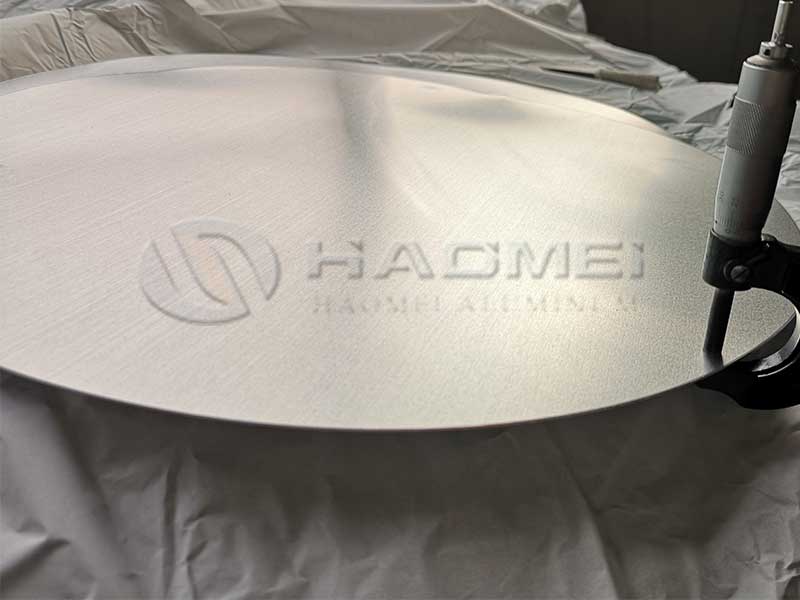

DC CC aluminium circle
In the cookware aisle or behind the smooth finish of a lampshade, it is easy to overlook that each perfectly round aluminium disc carries a story that begins long before the stamping press. The terms “DC” and “CC” attached to aluminium circles are not marketing codes; they are shorthand for two fundamentally different metallurgical routes—direct chill casting and continuous casting—that leave a lasting imprint on the circle’s microstructure, performance and cost.
DC CC aluminium circles from this process‑driven perspective reveals why two discs that look identical under room light behave so differently in a kitchen, a press shop or an anodizing bath.
Two Casting Stories Behind One Circle
Direct chill (DC) casting starts by solidifying molten aluminium into thick ingots, often hundreds of millimetres in cross‑section. These ingots are homogenized at high temperature, hot‑rolled to break down the cast structure, and finally cold‑rolled to the target gauge before being blanked into circles. The repeated deformation and thermal steps refine grains, dissolve segregated phases and smooth out composition gradients.
Continuous casting (CC) flips the script. Instead of thick ingots, a thin slab or strip solidifies continuously as the melt flows through a caster. The strip is then hot‑rolled minimally (or even directly cold‑rolled) to final thickness. This route is lean on process steps, energy and time, but the solidification front moves differently, often leaving a slightly coarser, more directionally solidified structure with more visible center‑line segregation if not carefully controlled.
From the outside, both routes can yield a bright, defections‑free circle. Under the microscope, grain morphology, precipitate dispersion and residual stress patterns tell which path the material took—and those microscopic differences control very macroscopic outcomes: how deep a pan can be drawn, how uniform a colour after anodizing, how a lid resists warping on a gas stove.
Alloys and Tempers: Matching Route to Role
Aluminium circles are rarely pure aluminium alone. The workhorse alloys for circles—especially for cookware, lighting and general stamping—are mainly from the 1xxx and 3xxx series:
- 1050 / 1060 / 1070 / 1100: Essentially pure aluminium with excellent ductility, high thermal conductivity, and outstanding corrosion resistance.
- 3003 / 3004 / 3105: Manganese‑alloyed for higher strength while keeping good formability and corrosion resistance.
- 5052 in some premium cookware: Magnesium‑alloyed for superior strength and excellent corrosion resistance, particularly when in contact with food and detergents.
The temper symbols (O, H12, H14, H18 and others) tell how much cold work and recovery the material has undergone. Typical tempers for circles include:
- O (annealed): Maximum softness and deep drawability, essential for deep pots, pressure cookers and complex spun shapes.
- H12 / H14: Half‑hard or slightly harder material, used when some strength and stiffness are required (for lids, shallow pans or reflectors), but draw depth is moderate.
- H18 or harder tempers: Applied rarely for circles that will be only lightly formed and where rigidity matters.
These alloys and tempers respond differently to DC and CC routes. Deep‑drawing 1050‑O benefits from DC’s fine, equiaxed grains and uniform composition, making wall thinning and orange‑peel less likely. Medium‑strength 3003‑H14 for shallow cookware or lamp reflectors is often well served by CC, where the cost advantage outweighs the slight compromise in deep‑draw performance.
Microstructure as a Design Parameter
From a distinctive technical viewpoint, DC and CC routes are not just “process options”; they are hidden design variables. Choosing between DC and CC is akin to selecting grain size, texture and segregation level as functional parameters.
DC‑cast aluminium circles typically show:
- More uniform grain structure through thickness due to intensive hot‑rolling reduction.
- Lower residual stress and improved planar anisotropy control, leading to consistent earing behaviour in deep drawing.
CC‑cast aluminium circles tend to exhibit:
- Slightly more pronounced crystallographic texture along the casting direction.
- Higher sensitivity to center‑line segregation if the caster and rolling schedules are not optimized.
- Adequate but somewhat narrower forming window, particularly noticeable in very deep or reverse draws.
For cookware that must be spun and deep‑drawn into high‑sided stockpots, these microstructural differences determine whether a forming line runs smoothly or becomes a scrap generator. For lighting reflectors where visual appearance and moderate deformation dominate, CC’s advantages in cost and strip availability can be decisive.
Chemical Composition Snapshot
While both DC and CC circles can use the same nominal alloys, their processing history heavily influences how these compositions manifest in practice. A concise reference for common circle alloys is useful:
| Alloy | Si (max wt%) | Fe (max wt%) | Cu (max wt%) | Mn (wt%) | Mg (wt%) | Others (each / total) | Al (approx.) |
|---|---|---|---|---|---|---|---|
| 1050 | 0.25 | 0.40 | 0.05 | 0.05 | 0.05 | 0.03 / 0.10 | ≥ 99.50 |
| 1060 | 0.25 | 0.35 | 0.05 | 0.03 | 0.03 | 0.03 / 0.10 | ≥ 99.60 |
| 1100 | 0.95 (Si+Fe) | – | 0.05–0.20 | 0.05 | 0.05 | 0.03 / 0.15 | Balance |
| 3003 | 0.60 | 0.70 | 0.05–0.20 | 1.0–1.5 | 0.05 | 0.05 / 0.15 | Balance |
| 5052 | 0.25 | 0.40 | 0.10 | 0.10 | 2.2–2.8 | 0.05 / 0.15 | Balance |
Surface: The Silent Messenger of Process History
Look closely at an anodized aluminium pan or a mirror‑finish reflector, and you are actually seeing the evidence of the preceding casting route.
DC aluminium circles usually offer:
- Excellent surface uniformity thanks to heavy hot reduction and thorough scalping of the ingot surface.
- Less banding or streaking during anodizing, important for decorative cookware and lighting.
- More stable response to high‑temperature non‑stick coating cycles, reducing the risk of pinholes or micro‑blistering.
CC aluminium circles, when produced on modern casters with tight control, can achieve surface quality as well. Yet their characteristic strip‑solidification pattern may make them more sensitive to:
- Slight colour variation across the width after anodizing, especially in demanding lighting applications.
- Orientation‑dependent reflectivity where very high optical standards are required.
From a distinctive viewpoint, the surface of a circle is not just a cosmetic attribute; it is a “readout” of solidification and rolling history that signals whether a product is better suited for a brushed kitchen utensil, a high‑gloss ceiling reflector, or a utility vessel where appearance is secondary.
Application Landscapes: Matching DC or CC to End Use
Applications cluster naturally around the strengths of each route.
DC aluminium circles tend to be preferred for:
- Deep‑draw cookware: Stockpots, saucepans, pressure cookers and kettles, especially in 1050‑O or 3003‑O where high elongation and uniform thickness are critical.
- Premium cookware bases: When combined with stainless steel cladding and induction plates, DC circles provide dimensional stability during multiple bonding and heating cycles.
- Decorative anodized products: High‑end lighting reflectors, polished lids and coloured kitchenware where colour consistency and gloss uniformity are essential.
- Precision spinning: Coffee pots, tea kettles, and specialty vessels where local thinning during spinning must be tightly controlled.
CC aluminium circles excel in:
- Shallow cookware and utensils: Frying pans, lids, pizza plates, pie plates and baking trays that require moderate forming and where cost competitiveness is crucial.
- General‑purpose kitchenware: Washbasins, small bowls, plates and camping cookware where very deep drawing is not required.
- Lighting fittings and reflectors of moderate forming depth: Downlight reflectors, lamp holders and decorative trims where the focus is on consistent supply at an economic price.
- Industrial stampings: Nameplates, flanges, small housings and covers where the forming strains remain modest.
In many factories, both DC and CC circles coexist on the same shop floor, assigned to different production lines according to the forming severity, coating stack and final product tier.
Implementation Standards and Quality Windows
To control variability, manufacturers align circle production with recognized standards:
- ASTM B209 and EN 485 for flat‑rolled products define mechanical properties, thickness tolerances and chemical composition.
- BS, ISO and GB standards in different regions further refine mechanical and dimensional requirements for cookware and lighting circles.
parameters monitored on DC and CC circles alike include:
- Tensile strength and elongation, adjusted to match drawing ratios and spinning requirements.
- Grain size and earing behaviour, determined via orientation tests that predict cup profile after deep drawing.
- Thickness and diameter tolerances, especially critical for high‑speed multi‑cavity presses.
- Surface quality criteria such as freedom from roll marks, pinholes, laminations and inclusions, tuned to the severity of anodizing or coating.
Yet behind identical certificates, the DC or CC origin configures how “robust” those properties are in real production. A DC‑based spec often delivers a slightly wider forming margin, useful when lubricant conditions or tool wear fluctuate. A CC‑based spec, when tightly controlled, provides an optimized balance between mechanical performance and cost.
Seeing Circles as Engineered Interfaces
DC casting writes a chapter focused on microstructural refinement and forming resilience, well suited to deep‑draw, high‑finish applications where the circle must endure complex shape changes and harsh thermal cycles. CC casting scripts a story of streamlined efficiency, supplying robust, economical circles ideal for shallow forming and cost‑sensitive products.
that distinction allows designers, buyers and production engineers to treat “DC” and “CC” as deliberate choices rather than incidental labels. The result is fewer forming surprises, longer tool life, better surface appearance and a more rational match between material, process route and the everyday objects that those circles eventually become.