
Aluminum foil 1050 1060 Mill Finish and Polished
Aluminum foil in the 1xxx series is often treated as "simple aluminum," but that label hides why 1050 and 1060 remain the quiet workhorses behind countless industrial and consumer products. Their appeal is not built on high strength or exotic chemistry; it comes from predictability, cleanliness, conductivity, and surfaces that can be tuned for function. When you look at 1050/1060 foil in mill finish versus polished, you're not just choosing an appearance-you're choosing how the foil interacts with light, heat, adhesives, coatings, forming tools, and even food or pharmaceutical environments.
A useful way to think about these materials is to treat the alloy as the "engine" and the surface as the "tire." The engine in both 1050 and 1060 is exceptionally pure aluminum; the tire is either the natural, rolled surface (mill finish) or a mechanically refined reflective surface (polished). They drive differently even when the core metal is similar.
What 1050 and 1060 really offer
Both alloys belong to commercially pure aluminum. In practice, that purity yields three dominant advantages: strong corrosion resistance in neutral environments, very good electrical and thermal conductivity, and excellent workability. Between the two, 1060 is typically purer than 1050, so it trends slightly higher in conductivity and corrosion resistance, while 1050 can be marginally more forgiving on some forming operations due to small compositional differences. In foil gauges, either can be processed extremely thin with stable quality, which is why they are frequent choices for heat transfer fins, insulation facings, tape backings, capacitor foils, and packaging laminates.
Typical chemistry (reference ranges)
Exact limits vary by standard and mill practice, but the table below captures commonly referenced ranges for these alloys used in sheet/foil production.
| Alloy | Al (min) | Si (max) | Fe (max) | Cu (max) | Mn (max) | Mg (max) | Zn (max) | Ti (max) |
|---|---|---|---|---|---|---|---|---|
| 1050 | 99.50% | 0.25% | 0.40% | 0.05% | 0.05% | 0.05% | 0.05% | 0.03% |
| 1060 | 99.60% | 0.25% | 0.35% | 0.05% | 0.03% | 0.03% | 0.05% | 0.03% |
If your application is sensitive to conductivity, etching response, or anodizing aesthetics, request the mill test certificate and confirm impurity ceilings, especially Fe and Si, which can influence surface appearance and reflectivity after finishing.
Temper and performance: the "softness" that enables foil to work
Foil is rarely used for tensile strength; it's used for how it bends, wraps, and bonds. Tempers for 1050/1060 foil commonly include O (annealed) and H1x/H2x/H3x strain-hardened variants depending on the target stiffness and forming response.
Annealed foil behaves like a cooperative film: it conforms with low springback, seals well in laminations, and forms crisply around edges without fighting the tool. H-temper foil behaves more like a thin sheet: it resists wrinkling and can offer better handling on high-speed converting lines, but with reduced ductility for aggressive forming.
Typical processing logic looks like this:
- Packaging and insulation facings often favor O temper for folding and conformability.
- Adhesive tapes and some fin/liner applications may lean to H18 or similar when higher stiffness and flatness retention are desired.
- For polishing and high reflectivity work, the temper choice influences how the surface responds to mechanical finishing and whether subtle "orange peel" texture becomes visible under specular reflection.
Mill finish: the honest surface of rolling
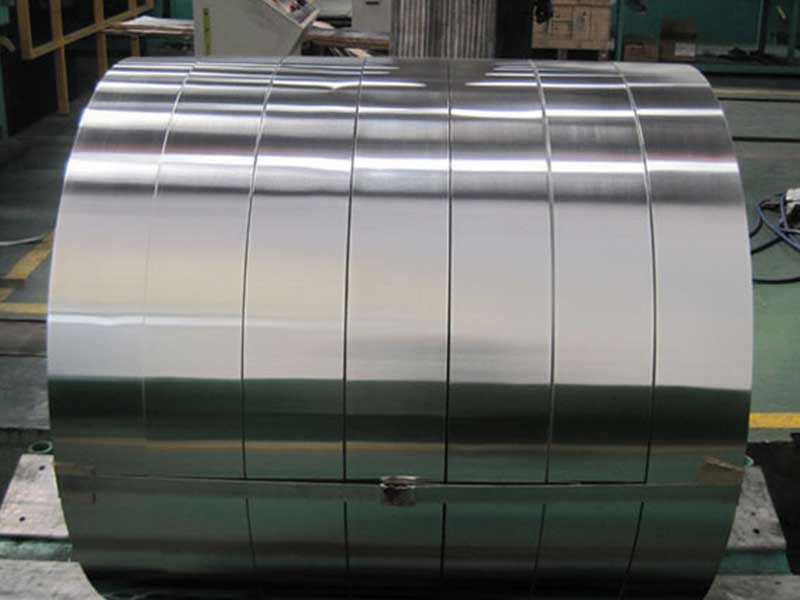
Mill finish is the as-rolled surface delivered from the foil rolling process. It carries the imprint of manufacturing in a controlled way: fine rolling lines, a natural metallic luster, and a surface energy that is generally friendly to coatings and laminations once cleaned and, if needed, chemically treated.
From a functional viewpoint, mill finish does several things well:
It supports reliable bonding. Adhesives, lacquers, and extrusion coatings often behave more predictably on a consistent rolled surface, especially when the foil is supplied with controlled cleanliness and surface roughness. For tape backings or laminated insulation, that predictability can matter more than high reflectance.
It behaves well in forming and converting. Mill finish foil can be slit, embossed, corrugated, and laminated at speed. Its microtexture can reduce the tendency for blocking and can improve "grab" in web handling.
It is cost-efficient and forgiving. If the product will be hidden inside a laminate, behind a coating, or inside an assembly, mill finish offers the performance without paying for optical perfection.
Where mill finish can be the wrong choice is where light management is the job. Rolling lines scatter light, so the surface becomes more diffuse. For insulation that relies on radiant barrier performance, you can still get value from mill finish, but polished surfaces typically deliver higher specular reflectance, which is often what designers actually want when they say "reflective."
Polished foil: when optics become a material property
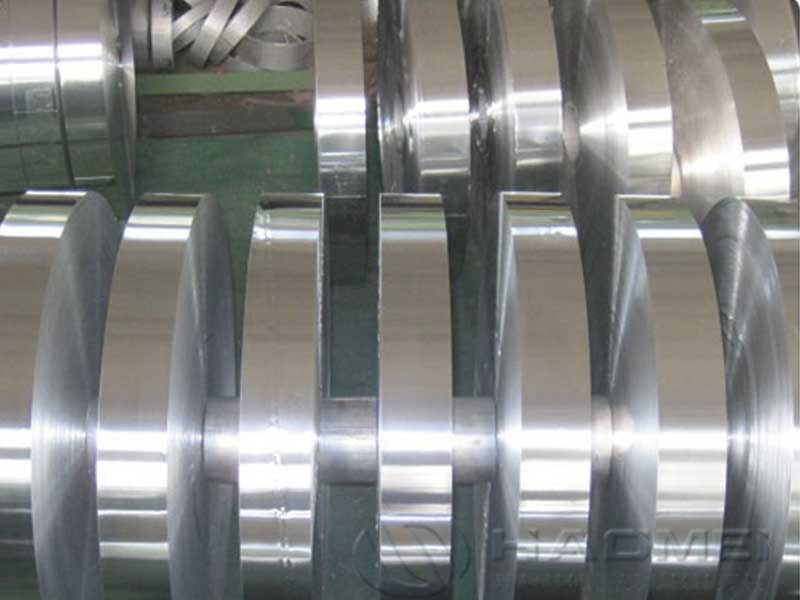
A polished 1050/1060 foil is not simply "shinier." Polishing changes how the surface behaves as a thermal and visual tool. When surface roughness drops and the foil becomes more specular, it behaves like a controlled mirror rather than a metallic gray.
That difference shows up in several application families:
Reflective insulation and radiant barriers benefit because radiant heat transfer is strongly affected by surface emissivity and reflectivity. A polished surface can push performance in designs where the foil faces an air gap and radiative exchange dominates. The foil stops being only a facing material and becomes an active thermal component.
Lighting and decorative trim use polished foil as a lightweight reflector or aesthetic layer. Here, the purity of 1050/1060 becomes a quiet advantage: fewer alloying elements can mean fewer color shifts and more consistent brightness after finishing.
Heat management systems can also use polished foil strategically. In some designs, you want controlled reflection or reduced absorption from nearby heat sources. While aluminum is generally thermally conductive regardless of finish, the surface condition changes radiative behavior, which can matter at distance or across gaps.
Polishing does introduce trade-offs. Highly reflective surfaces are more sensitive to handling marks, roll pressure defects, and micro-scratches. They can also complicate some adhesive systems if the finishing lowers surface roughness too much; in those cases, surface treatment (corona, primer, chemical conversion) becomes part of the specification rather than an afterthought.
Technical details that matter more than people expect
Foil thickness and tolerance shape how both finishes perform. Thin gauges magnify surface defects; a scratch that's invisible on thicker sheet becomes obvious on thin polished foil. If optical performance is critical, specify tight gauge tolerance and surface defect limits, not only "polished."
Cleanliness and oil residue are decisive. Rolling oils protect during processing but can interfere with lamination, printing, or sealing. For packaging, pharmaceutical, or electronics applications, request controlled residual oil and consider degreasing or annealed, low-residue supply.
Pinholes and porosity are a real design parameter. In ultra-thin foil, pinholes can affect barrier properties and dielectric performance. For capacitor or insulation barrier use, define pinhole limits and test methods upfront.
Grain structure influences appearance after polishing. Coarse grains or uneven recrystallization can create texture that becomes visible as waviness under specular light. This is where temper, annealing practice, and finishing method meet; mills that control recrystallization tightly tend to deliver better cosmetic uniformity.
Standards and typical supply expectations
1050 and 1060 foil are commonly supplied under widely used aluminum standards such as ASTM B479/B479M (aluminum foil for flexible packaging and related uses) or EN 546 series (aluminum and aluminum alloys foil). For chemical composition in wrought aluminum, standards such as ASTM B209/B209M or EN 573 are often referenced for composition and general requirements, while product-specific foil standards define gauge tolerances, pinhole limits, mechanical properties, and surface quality.
If you're buying for a converting line, the "standard" you need is often not only the alloy standard but also a mutually agreed technical delivery condition: temper, surface finish designation, allowed splices, coil set limits, and inspection criteria under controlled lighting for polished products.
Choosing between 1050 and 1060, mill finish and polished: a practical viewpoint
If the foil's job is to be a stable, clean, formable, bondable substrate, mill finish 1050 or 1060 is usually the most rational choice. If the foil's job is to manage light or radiant heat, or to be visibly reflective as part of the product identity, polished surface becomes the functional upgrade, not a cosmetic indulgence.
Between 1050 and 1060, the decision often comes down to how sensitive the application is to conductivity, corrosion margins, and appearance consistency after finishing. 1060 can provide a small but meaningful edge in those areas; 1050 is widely available and performs exceptionally well across general-purpose foil applications.
In the end, "mill finish versus polished" is not a styling debate. It's an engineering decision about how aluminum should interact with its environment. With 1050 and 1060 foil, that interaction can be tuned with remarkable precision-without abandoning the simplicity that made pure aluminum indispensable in the first place.
https://www.al-alloy.com/a/aluminum-foil-1050-1060-mill-finish-and-polished.html