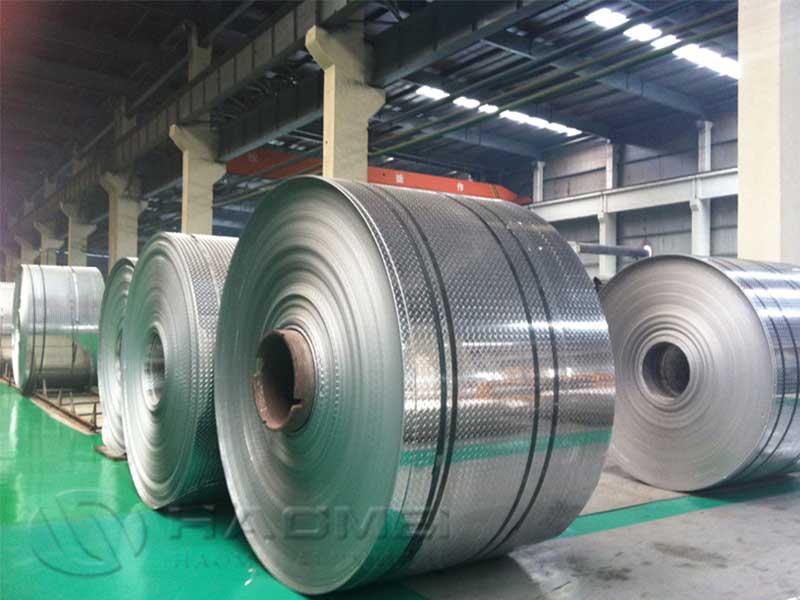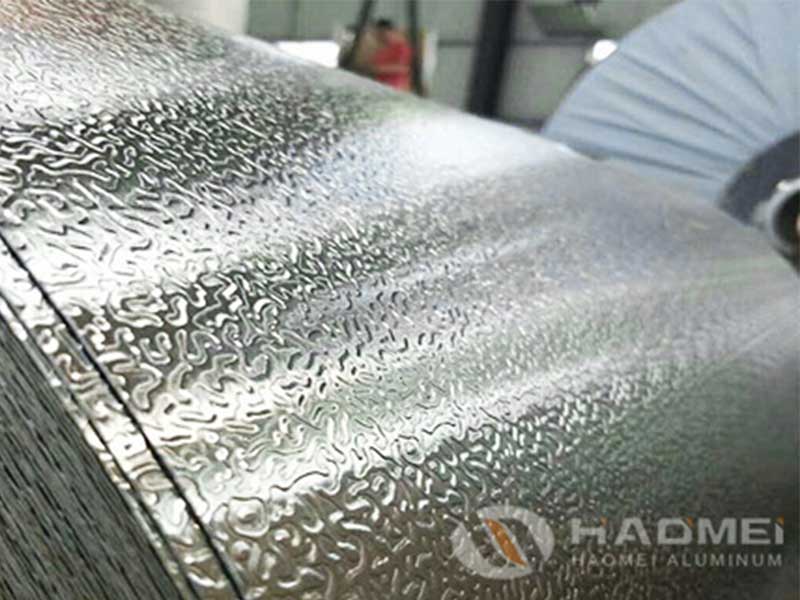

Embossed aluminum sheet mill finish 5052
In the world of sheet metals, "finish" is often treated like a cosmetic decision-something chosen late, after the alloy and thickness are set. Embossed aluminum sheet in mill finish 5052 flips that thinking on its head. Here, the surface geometry is not decoration; it becomes a functional layer that changes grip, stiffness, wear behavior, and even how the metal hides the story of daily use. From this perspective, the sheet is less a flat commodity and more a tuned interface between humans, environments, and structures.
Why 5052 behaves differently when you emboss it
5052 is an Al-Mg alloy built around corrosion resistance and dependable formability. Its magnesium content makes it notably stronger than 1xxx series "pure" aluminum, while still remaining friendly to bending and shaping. When you emboss a 5052 sheet, you're not simply imprinting a pattern-you're redistributing local strain, creating a topography that interacts with load, friction, and contact pressure.
Embossing forms peaks and valleys. Those raised features act like miniature ribs that can improve apparent stiffness in use, particularly in panels that might otherwise drum or flutter. At the same time, valleys can help conceal scratches, scuffs, and handling marks that would be painfully obvious on a flat, reflective surface. This is why embossed 5052 often feels "industrial honest": it doesn't try to stay pristine; it tries to stay functional.
Mill finish: not unfinished, but unmasked
"Mill finish" sometimes gets mistaken for "rough" or "incomplete." In reality, mill finish is an uncoated baseline surface as it comes from rolling, usually with subtle directionality and a natural oxide film. Pairing mill finish with embossing creates a pragmatic combination: the sheet is economical and immediately usable, while the pattern reduces the visibility of roll marks and common abrasions.
There is another advantage that's easy to miss: coatings and anodizing can amplify defects if pretreatment isn't perfect. Mill finish embossed 5052 is often chosen when consistency and throughput matter more than showroom reflectivity, or when the downstream user intends to add their own coating system optimized for the final environment.
Technical profile that drives real-world choices
The value of embossed aluminum sheet mill finish 5052 comes from the intersection of alloy chemistry, temper, and pattern-induced geometry. The alloy is typically supplied in tempers that balance strength with formability, and embossing itself introduces cold work at the surface.
Commonly specified tempers include O (annealed) for maximum formability, H32 for a stable balance of strength and workability, and H34 when higher strength is desired with reduced formability. For many embossed sheet applications-walkways, liners, and covers-H32 is widely favored because it resists denting better than O while still bending without excessive cracking when the correct bend radius and direction are selected.
General implementation standards frequently referenced in procurement include ASTM B209 for aluminum and aluminum-alloy sheet and plate. For applications where slip resistance is critical, surface pattern selection and validation may be aligned with internal safety requirements or regional guidance for walking surfaces, though embossed aluminum patterns are often evaluated by practical testing rather than a single universal standard.
Chemical composition and what it implies
The chemistry of 5052 is the quiet engine behind its saltwater-capable reputation. Magnesium strengthens aluminum and improves corrosion resistance in many environments, particularly marine atmospheres. Chromium, present in small amounts, contributes to corrosion performance and structure stability.
Below is a typical compositional range used for 5052 (values in weight percent). Actual mill certificates should be used for acceptance.
| Element | Typical Range (wt. %) |
|---|---|
| Mg | 2.2–2.8 |
| Cr | 0.15–0.35 |
| Si | ≤0.25 |
| Fe | ≤0.40 |
| Cu | ≤0.10 |
| Mn | ≤0.10 |
| Zn | ≤0.10 |
| Ti | ≤0.15 |
| Al | Remainder |
From a distinctive viewpoint, think of this chemistry as "corrosion-first strength." It's not built to win the absolute strength contest; it's built to keep performing when water, salts, and everyday contaminants try to turn surfaces into maintenance problems.
Embossing patterns as engineered behavior
Embossing is often described visually-diamond, stucco, five-bar, tread-but the more useful description is mechanical. Patterns change contact mechanics. Raised features reduce the real contact area in some interactions while increasing edge effects in others. That matters for grip, wear, and dirt retention.
In flooring or step covers, raised patterns increase traction by interrupting a thin film of water or debris and by providing bite points for shoe soles. In protective cladding, the pattern helps mask dents and handling damage, extending the period before a surface "looks worn." In transportation interiors, embossed sheet can reduce glare compared with bright flat sheet and can also dampen the appearance of vibration-related fretting marks.
Embossing also changes how sheet behaves in fabrication. Deep patterns can slightly complicate tight-radius forming because the geometry creates thickness variation in the direction of deformation. In practice, fabricators account for this by selecting appropriate bend radii, orienting bends relative to the rolling direction, and avoiding placing critical bends across the most aggressively raised features unless the temper and radius allow it.
Tempering, forming, and joining realities
5052 does not respond to heat treatment the way 6xxx alloys do; it is non-heat-treatable in the strengthening sense. Strength increases primarily through strain hardening, reflected in H tempers. This matters when an embossed sheet is welded. Heat from welding can locally soften strain-hardened areas, reducing strength near the weld. Designers who treat the sheet as a system will either place welds away from peak stress zones, increase local thickness, or use mechanical joining where appropriate.
5052 is generally weldable with common aluminum filler choices, and it retains good corrosion resistance after welding if proper practices are followed. For riveting and fastening, embossed surfaces can be advantageous because they resist visible "oil canning" and help hide minor distortions around fasteners.
Where mill finish embossed 5052 fits best
Marine and coastal infrastructure is the most intuitive home: dock components, hatch covers, boat interiors, equipment enclosures, and splash-zone panels benefit from 5052's resistance to corrosion and pitting in many real-world conditions. The embossed texture adds grip and damage concealment, two attributes that matter when surfaces are wet, sandy, and constantly handled.
Transportation and utility platforms make another strong case. Embossed 5052 is used for step treads, access panels, trailer interiors, and protective linings where operators need secure footing and owners want a surface that doesn't advertise every scrape. The mill finish keeps costs predictable and avoids the lead time and variability that can come with painted systems when the end user is prepared to maintain or coat the sheet to their own specification.
Food and chemical-adjacent environments sometimes use embossed 5052 for non-contact structural panels, guards, and covers, where cleanability is important but high-end aesthetics are not the priority. The natural oxide film offers baseline protection, and the pattern can reduce the visibility of smudges and minor abrasion. If hygiene requirements demand it, users may choose additional surface treatment, but many practical enclosures and liners begin with mill finish for flexibility.
Architectural and industrial design applications also adopt embossed mill finish 5052 precisely because it is not overly perfected. The pattern reads as intentional, while the mill finish communicates material authenticity. It can be left as-is for a raw industrial look or used as a substrate for powder coating, where the embossing helps hide minor substrate imperfections and adds tactile depth.
A practical selection mindset
Choosing embossed aluminum sheet mill finish 5052 is less about chasing a single headline property and more about assembling a reliable surface. You're buying corrosion resistance that tolerates harsh atmospheres, formability that behaves in real fabrication shops, and a texture that turns everyday abuse into background noise. In many applications, the embossing is doing as much work as the alloy-adding grip, adding stiffness feel, and adding visual longevity-while mill finish keeps the material honest, adaptable, and cost-efficient.
https://www.al-alloy.com/a/embossed-aluminum-sheet-mill-finish-5052.html